Helen Luhaäär · Data Analyst, Bouygues UK · November 2024 presentation
Bouygues UK
Bouygues UK connected delivery and hoist booking choices to the limits of a restricted construction site. The workflow checked notice periods and permitted combinations while keeping approval, rejection and urgent exceptions with the logistics team.
Bouygues UK · November 2024
Connected delivery and hoist bookings for a restricted site
A delivery slot had to fit more than a diary. Helen Luhaäär and the logistics team at Bouygues UK connected gate and hoist bookings to the restrictions of a complex construction site.
In the workflow presented in November 2024:
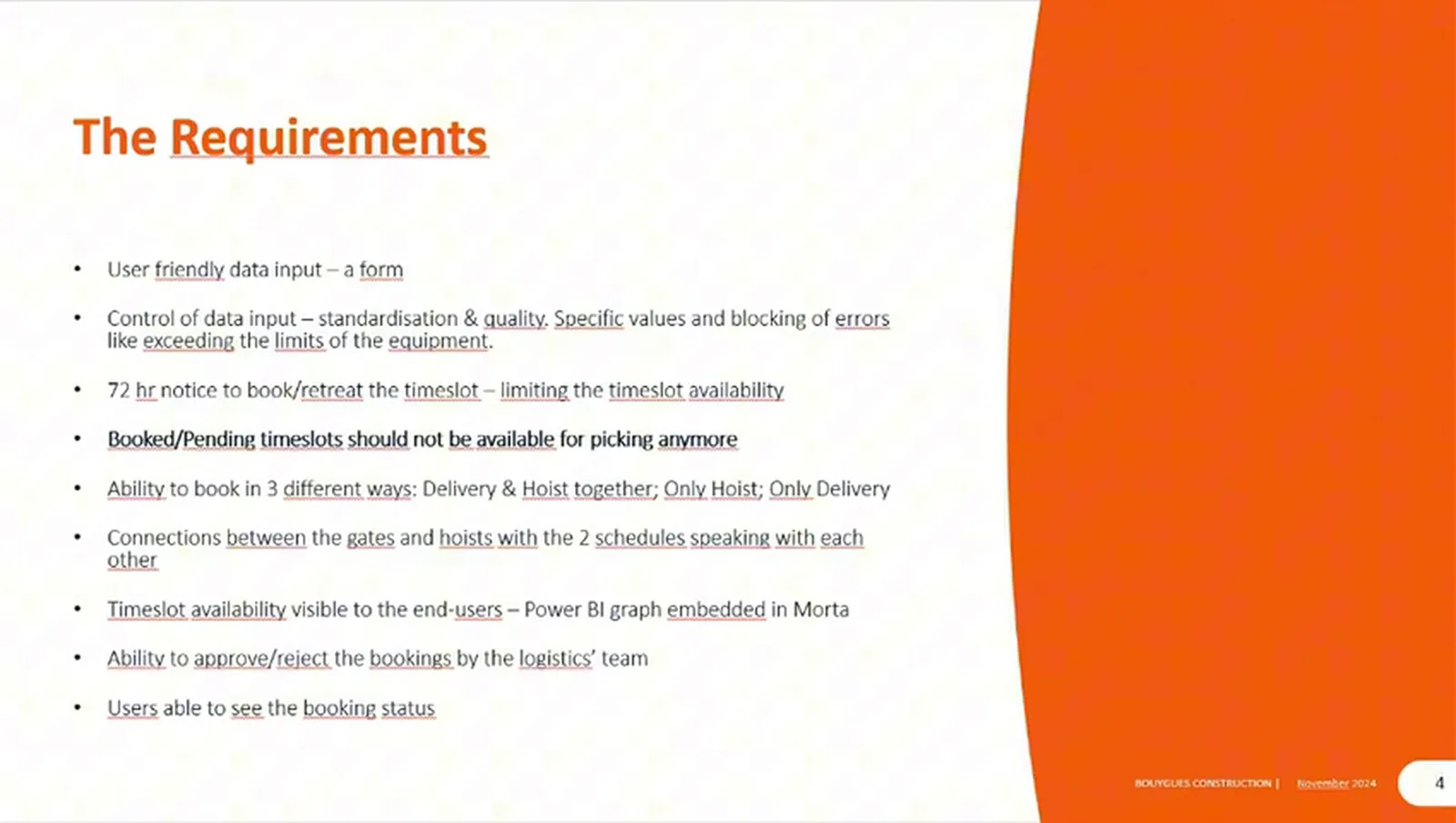
- 3 booking routes: delivery and hoist together, hoist only, or delivery only.
- More than 72 hours’ booking notice: the displayed date check required the requested start to be more than 72 hours ahead.

Executive summary
Bouygues UK needed to coordinate deliveries around limited storage, offloading capacity and equipment access. Helen Luhaäär built a Morta booking workflow using logistics information from Liliana Crisan. Bookers could inspect a Power BI availability chart, then choose from permitted times and gate–hoist combinations. Material and equipment requirements governed the information they supplied, while a date check rejected requests with insufficient booking notice. The logistics team retained approval and rejection decisions, including the authority to override an automatic rejection for an urgent request. The resulting status was visible to the booker, who could also use a separate view to withdraw eligible bookings.
The results
The configured workflow gave bookers a way to select a permitted request and follow its outcome. Taken times were absent from the booking choices. After submission, a visible status distinguished a request awaiting review from one that had been rejected or approved.
For the logistics team, separate views distinguished bookings needing review from those already reviewed. The team could make a decision, add comments and download the day’s booking information for meetings about what was coming to site.
The challenge
Bouygues UK’s complex projects had limited storage and offloading capacity. Gates, locations and equipment imposed different size and weight restrictions. Helen’s team needed a booking process that reflected those physical constraints, and she had found that the available systems did not accommodate their combination of requirements.
There were three ways to book: a delivery with a hoist, a hoist for someone already on site, or a delivery without a hoist. The gate and hoist schedules had to stay connected across those routes. The team’s requirement was to exclude pending and approved slots from other bookers’ choices, keeping an occupied time from being offered through another booking route.
The solution
Choose a permitted slot
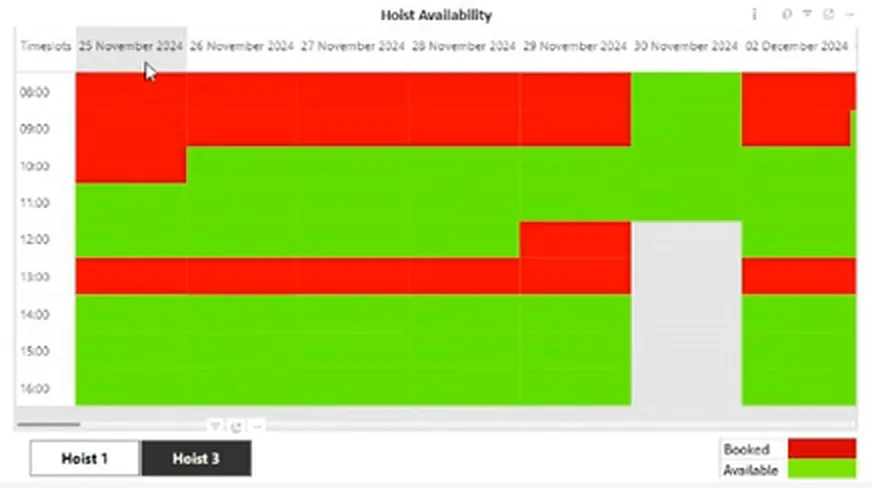
Available time and suitable equipment are separate checks. The booking page combined an embedded Power BI availability chart with form choices constrained by the schedules and the selected hoist.
Bookers could switch between hoists in the chart, where red marked booked slots and green marked available ones. For Hoist 3 on 28 November, the 08:00 and 09:00 slots were already taken. Those times did not appear in the form, directing the booker to the remaining available choices.
The form also restricted the gate associated with a hoist. Although there were six gates, Helen’s example allowed only Gate 5 for Hoist 3. Selecting the hoist narrowed the gate list before submission, keeping the booker’s request within that permitted combination.
Documents and instructions appeared before the form. Its first question asked the booker to acknowledge them, making that acknowledgement part of the request.
Enforce booking notice and retain urgent exceptions
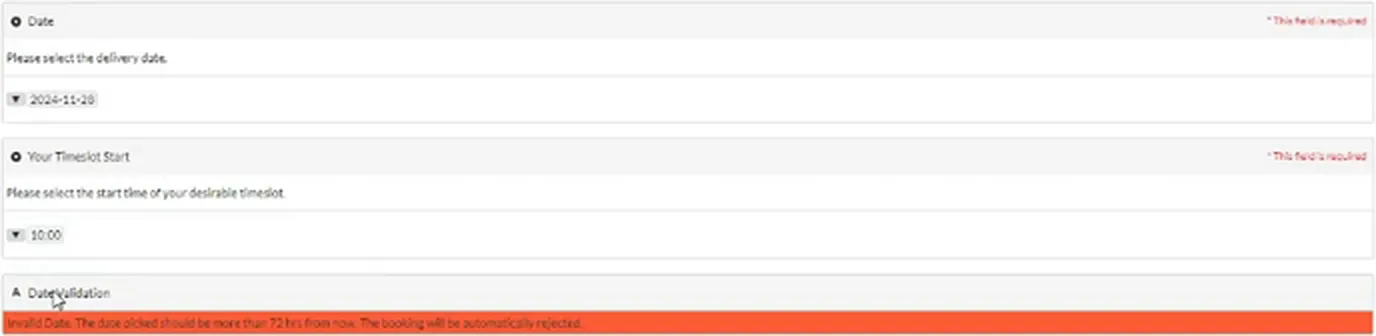
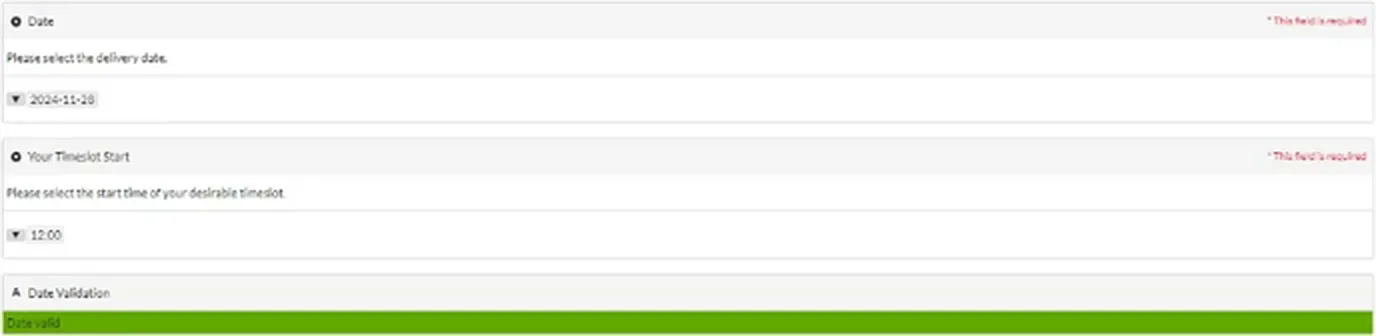
A time could be available but too close to meet the booking-notice rule. In Helen’s demonstration, selecting 10:00 on 28 November produced a warning that the requested start had to be more than 72 hours ahead. Changing it to 12:00 passed the date check.
Ignoring the warning did not reserve a slot. If the booker submitted the request anyway, it was automatically rejected. The check therefore affected the booking outcome, not just the message displayed beside the date.
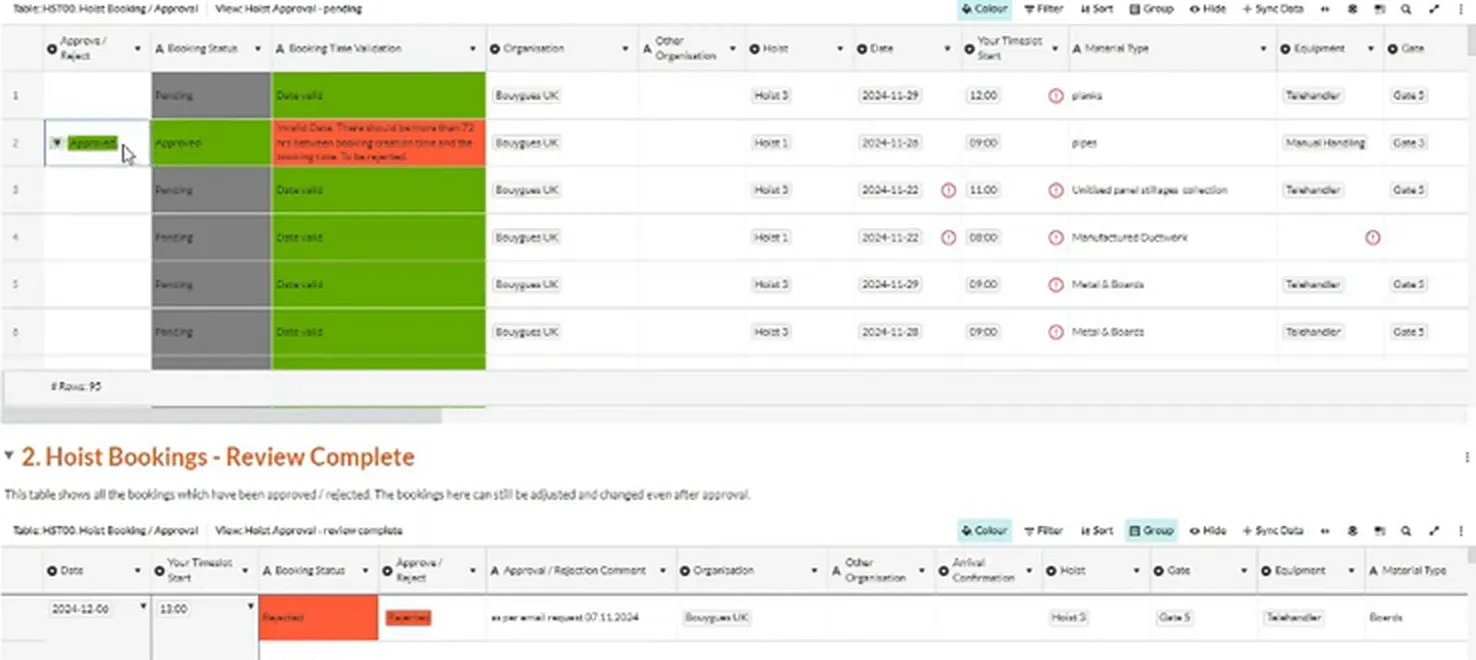
The logistics team could still override that rejection for an urgent request. Its approval carried through to the booker’s visible status, allowing the booker to see that the exception had been agreed. The notice rule constrained the request without taking that decision away from logistics.
Check the material and equipment requirements
The selected material determined what evidence the booker had to supply. Timber or wood required a certification upload, while other materials did not trigger that requirement. The request therefore carried the documentation required for that material.
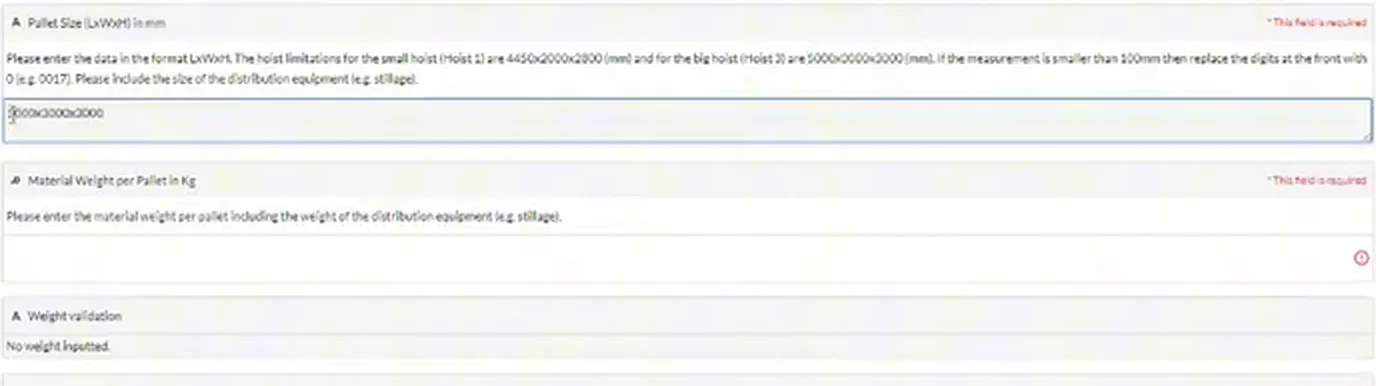
The form also asked for pallet dimensions, material weight and vehicle information. These inputs described the load and vehicle against the equipment requirements. For dimensions beyond the configured hoist limit, submission was blocked, preventing the booker from sending an oversized request through the form.
Give logistics a clear review process
The logistics team used separate views for pending and completed reviews. Reviewers could approve or reject a booking and add comments, with the completed review moving to the second table. This separated requests still needing a decision from those already dealt with.
Bookers could see the resulting booking status. The team could also download the day’s booking information for meetings, giving it a list of expected arrivals to work through when coordinating site activity.
Withdraw an eligible booking
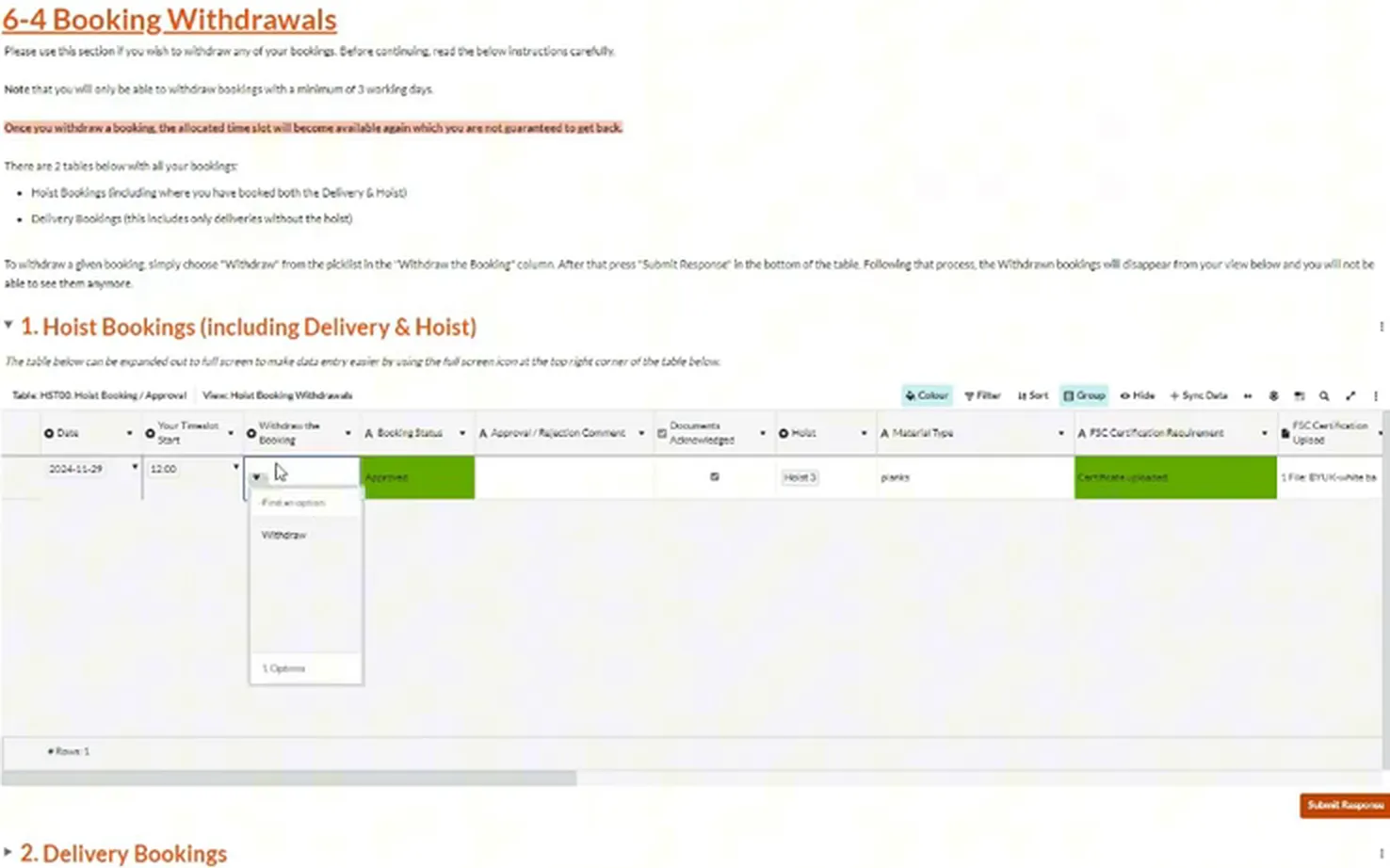
Withdrawal used a separate view containing bookings eligible under its advance-notice rule. In Helen’s example, a booking for the following day was absent, so the booker could not select it for withdrawal there.
An eligible approved booking for 29 November at 12:00 was available. Helen selected Withdraw, then submitted the change to confirm it. The view controlled which booking could be selected, and submission completed the booker’s withdrawal action.
The implementation
Liliana Crisan, identified as a Logistic Assistant in the presentation, supplied the logistics information. Helen, the data analyst, used it to build the booking workflow. Their separate contributions connected knowledge of site operations with the form, schedules and review controls.

The requirements covered the whole request: selecting a time and access route, supplying equipment-related information, receiving a decision and withdrawing an eligible booking. Helen carried those requirements into the booking process, while the logistics team retained the authority to approve requests and urgent exceptions.
About Bouygues UK
Bouygues UK is a UK construction and property development company, part of Bouygues Construction. Its work spans housing, healthcare, education, science and research, and data centres.
Start with the site’s booking decisions
A booking process needs to connect availability with the restrictions on the gate, hoist and load. Those decisions determine which choices a booker can make and which checks a request must pass. Approval authority is a separate part of that design, giving the logistics team the decision on exceptions that the standard notice rule would reject.
