Standardising Information Management: From Projects to Enterprise
Kier extended an information delivery planning approach from Ministry of Justice pathfinder projects into its regional construction business, using a controlled template, project-agreed responsibilities and connected reporting from project to business level.
Kier Group · 25 November 2024
Featuring Colin Bell, then Digital Construction Director at Kier Group, and Tom Crossley, then Automation Lead at Kier.
Recorded: 25 November 2024 · Running time: 28 minutes
Watch the presentation, or read below.
Kier took an information delivery planning approach developed on Ministry of Justice (MoJ) pathfinder projects into its regional construction business. A common template gave projects a consistent starting point. Agreed responsibilities and connected reporting made the information useful to the teams maintaining it.
- 20 projects were live within three or four weeks of the October 2024 launch, according to Colin.
- Seven parts of Kier's construction business each had an individual success plan centred on information delivery planning.
Executive summary
Kier moved from breakable spreadsheet handling to connected planning, delivery and reporting. Its standard information delivery plan (IDP) template preserved a common data structure while accommodating client requirements. The Automation Team controlled requests, development and testing, and project teams agreed responsibilities around their people and resources. Information suppliers entered planning data in Morta, while Viewpoint supplied delivery information. Construction teams could inspect progress against plan, clients could receive their required MIDP, and offices, regions and the business could compare common data and drill into detail. Further integrations were in testing, with supply-chain decision use part of the longer-term direction.
Simplification as the goal
Smaller regional projects had fewer resources than Kier's strategic projects. Colin wanted to carry the MoJ pathfinder approach into those teams without adding unnecessary work. Capturing information once and reusing it reduces opportunities for error. For Colin, that consistency also served the business aim of protecting margin.
Standardisation has to enable simplification. Colin's test was doing two or three steps instead of eight or nine. A consistent template had to reduce the work around information delivery, with the people using it able to see a return for their contribution.
But we only add if we're removing, if that makes sense.
Colin Bell
From project learning to a regional template
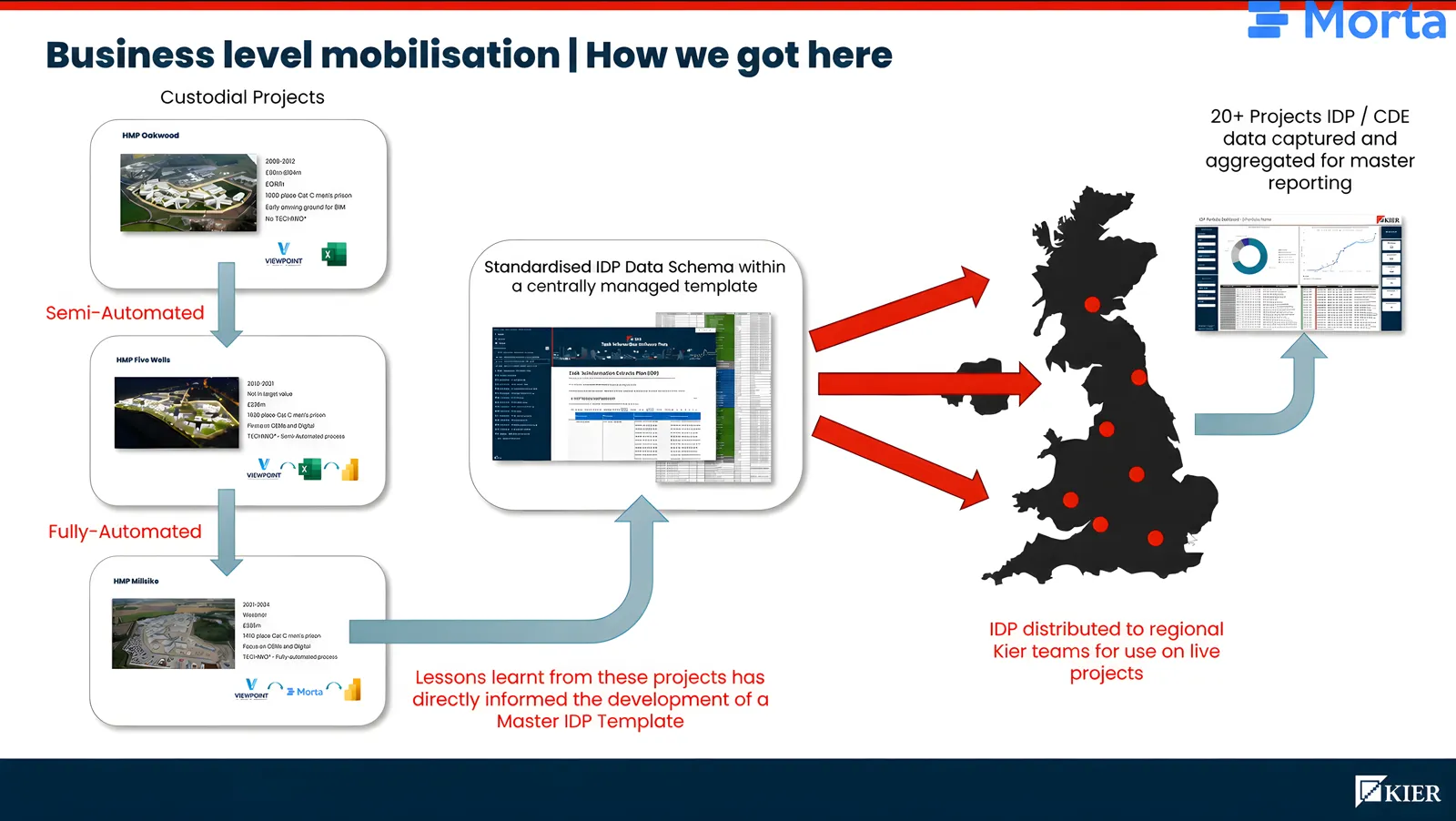
Tom's experience across Kier's prison projects showed how the workflow had changed. On HMP Oakwood, the team exported Viewpoint information into Excel and counted from the resulting sheets. HMP Five Wells added Power BI, but the route remained manual. Changes to spreadsheets and templates could break it.
At HMP Millsike, Kier connected Viewpoint to Morta and then to Power BI automatically. Morta held the standard template and validation rules, giving the team control over the dataset used for planning and reporting. This addressed the casual spreadsheet changes that had disrupted the earlier workflow.
Before January 2024, Kier and Morta had been developing the approach for the strategic MoJ projects. Kier decided in March 2024 to create an enterprise partnership with Morta and selected Tom to help scale the work. The regional approach was introduced at Kier's Digital Forum in September and went live in October.
Colin credited Tom and the supporting team with the templates, documentation, guidance and support beneath that launch. These gave regional teams material they could use beyond the original project. Demand also brought a capacity problem. Within the first three or four weeks, the pipeline was already more than Tom could handle, and Colin expected to involve more of Tom's team.
How project setup was controlled
The regional template contained a common data schema covering IDP and common data environment (CDE) information. Requirements for clients including the MoJ, Department for Education and Defence Infrastructure Organisation could be added over that core. Kier's Automation Team held the template centrally and controlled requests and changes, giving projects a route to meet their client requirements while retaining the structure needed for common reporting.
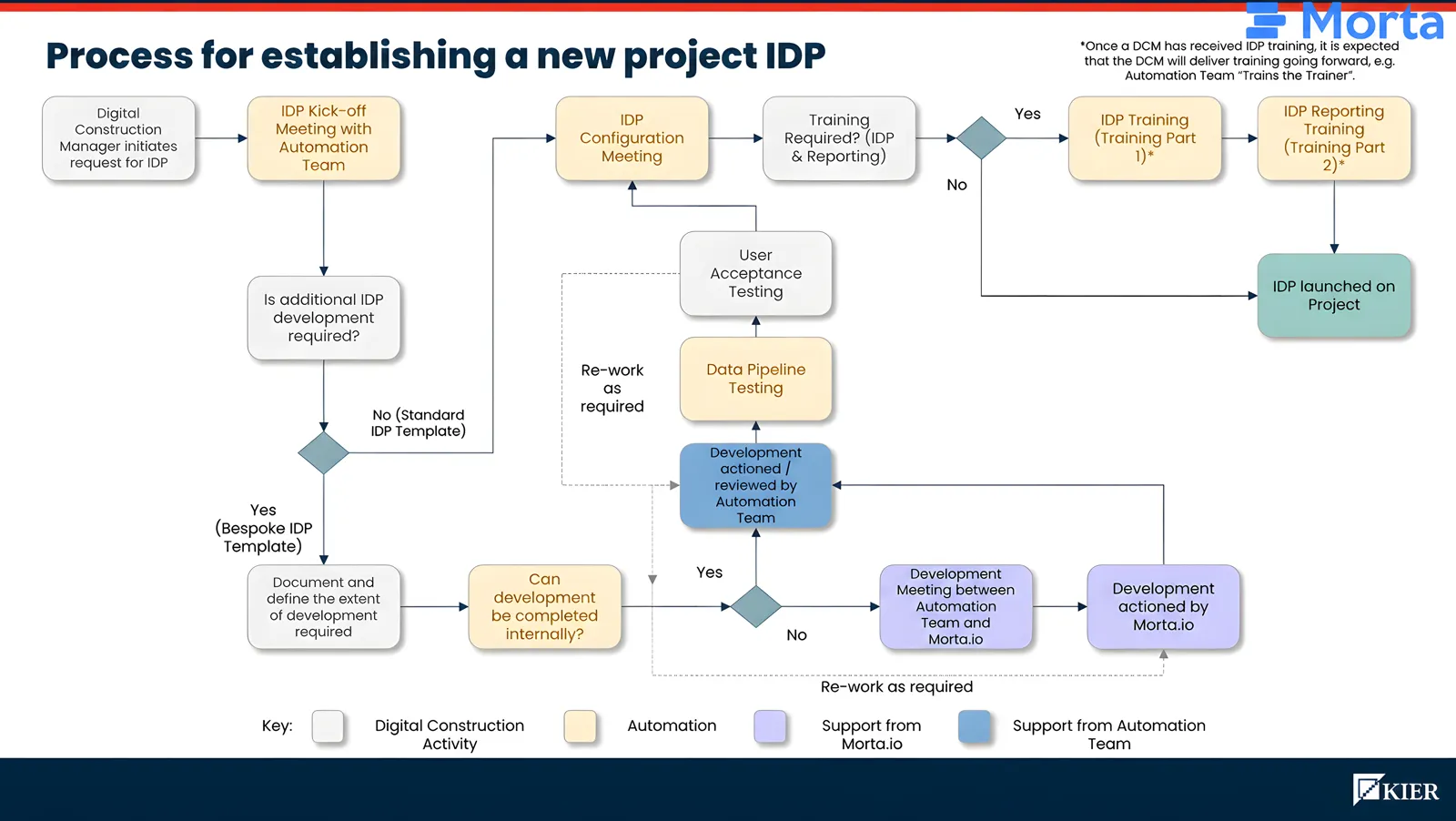
A Digital Construction Manager requested a new IDP. At a short kick-off, the Automation Team established whether the standard template was suitable, what additions were needed and what support the project required. A standard setup could proceed to configuration. Where bespoke development was required, the team defined the work and completed it internally where possible, involving Morta when needed. Data-pipeline testing and user acceptance testing came before configuration and launch of those changes.
Training covered both the IDP and its reporting. The Automation Team prepared Digital Construction Managers to train others, giving projects local support for using the template. Tom also warned that flexibility could quickly let the standard drift. Controlling development and testing allowed project needs and regional learning to be incorporated without leaving each team to change the common structure independently.
Responsibilities people could use
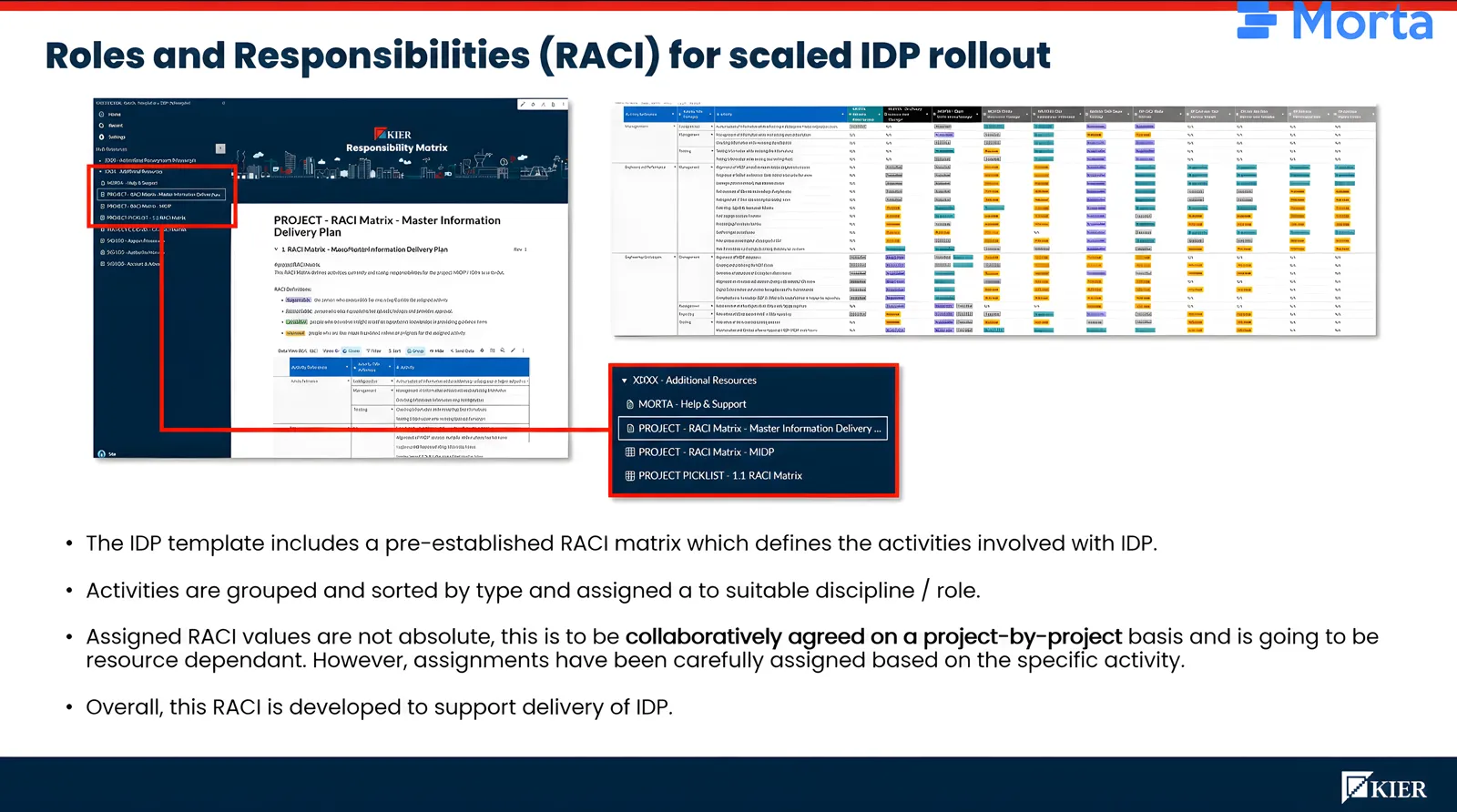
Kier built a responsibility matrix into the template, grouping activities and assigning them to roles including Digital Construction Manager, Design Manager, Information Manager and Information Coordinator. Each project team agreed the assignments for its actual people and resources. Contributors could then see which part of the IDP they were expected to maintain, while reporting returned the delivery information that work supported.
Colin connected this to his WIIFM model, meaning what's in it for me. Knowing the task was one side of the exchange. The other was being able to use the information, whether to inspect a deliverable's status or drill into detail relevant to the person's work. In Colin's reasoning, ownership gave people more reason to care about the information they maintained.
People understand that they're doing something and, by doing it, they're getting a return on that.
Colin Bell
Planning and delivery from the same information
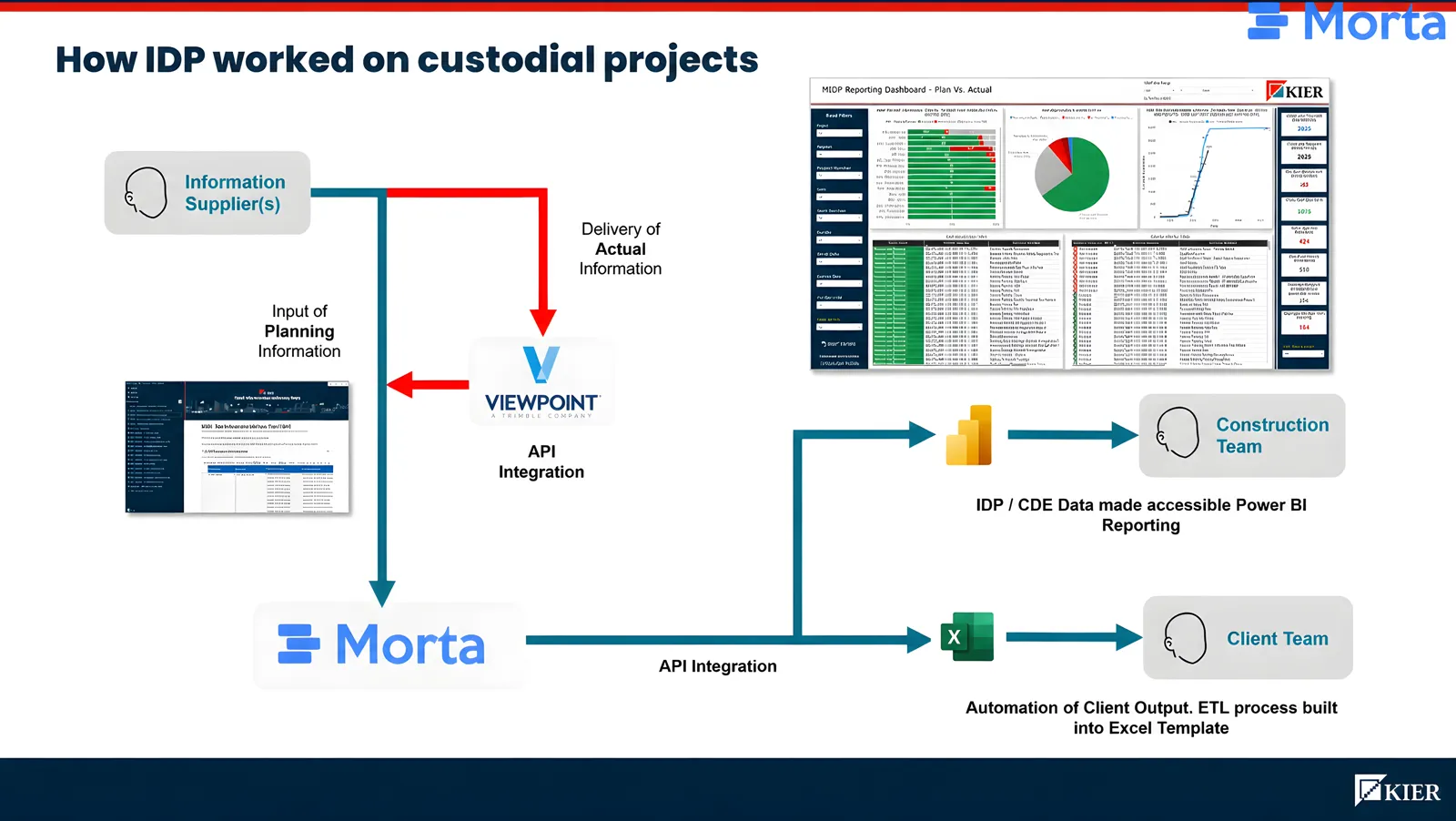
Information suppliers, including consultants, engineers, subcontractors and specialists, entered planning information into the project IDP in Morta. Viewpoint supplied information about what had been delivered. Construction teams could compare delivery against the plan, inspect late or undelivered information and follow performance over time.
Client teams needed the master information delivery plan (MIDP) in the format required for their CDE. The same underlying planning information could be returned through an Excel output for the client's checking, while Power BI gave construction teams a visual view of delivery. Each team received the form of information it needed from the common dataset.
Comparable data for different decisions
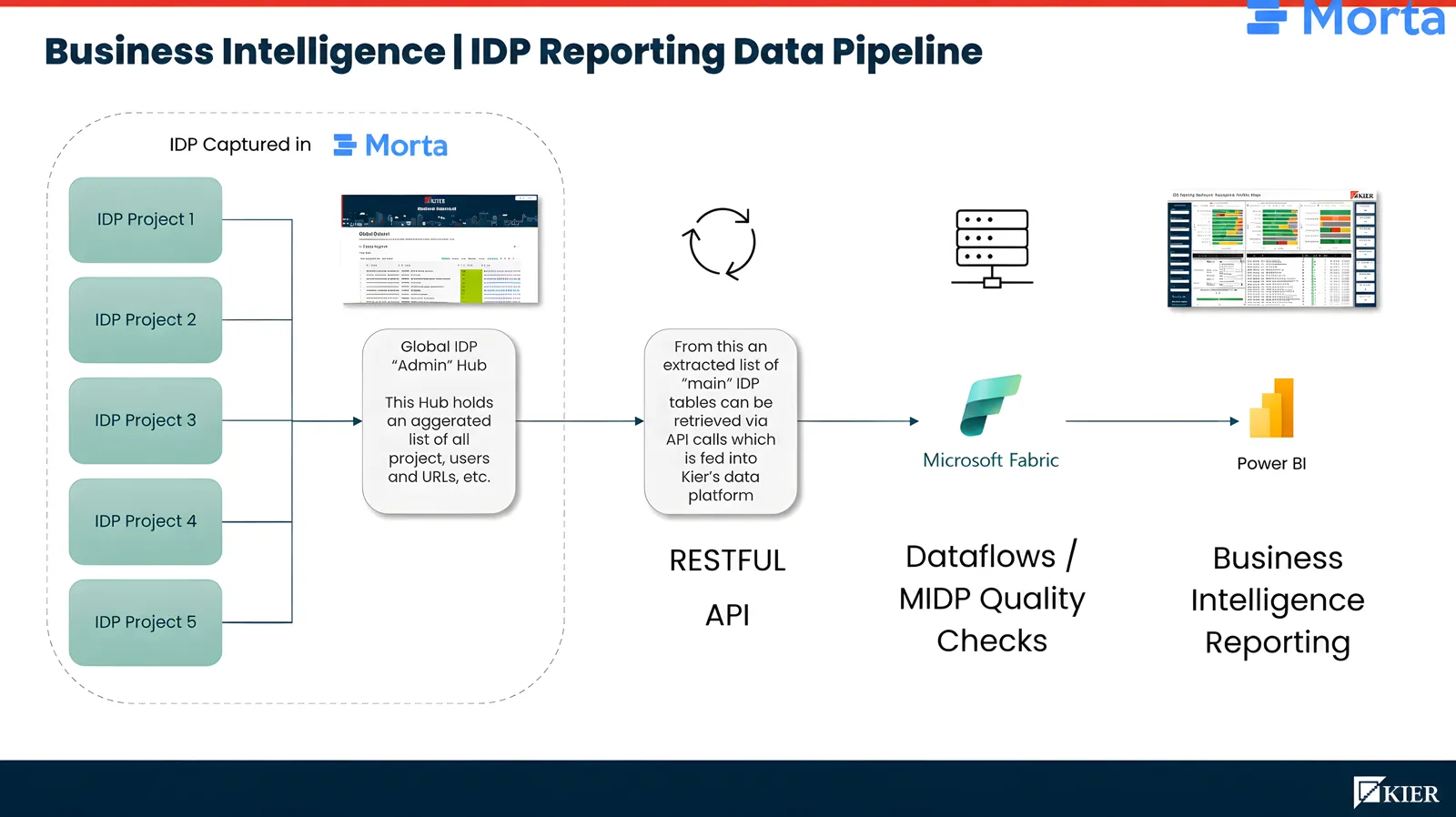
Using a standard template allowed Kier to synchronise project resources into an administration hub and identify the resources sharing its data schema. An aggregated list of those resources fed API retrieval into Microsoft Fabric and Power BI. Regional and business users could then compare information by region, office, project or originator and drill into the detail behind a result.
Project differences still needed interpretation. Role codes, functional breakdowns and spatial breakdowns could vary from the common schema. Tom's team used master mapping tables to interpret those differences and return them to a comparable form for reporting. This let higher-level users compare projects while retaining the detail needed to understand individual deliverables.
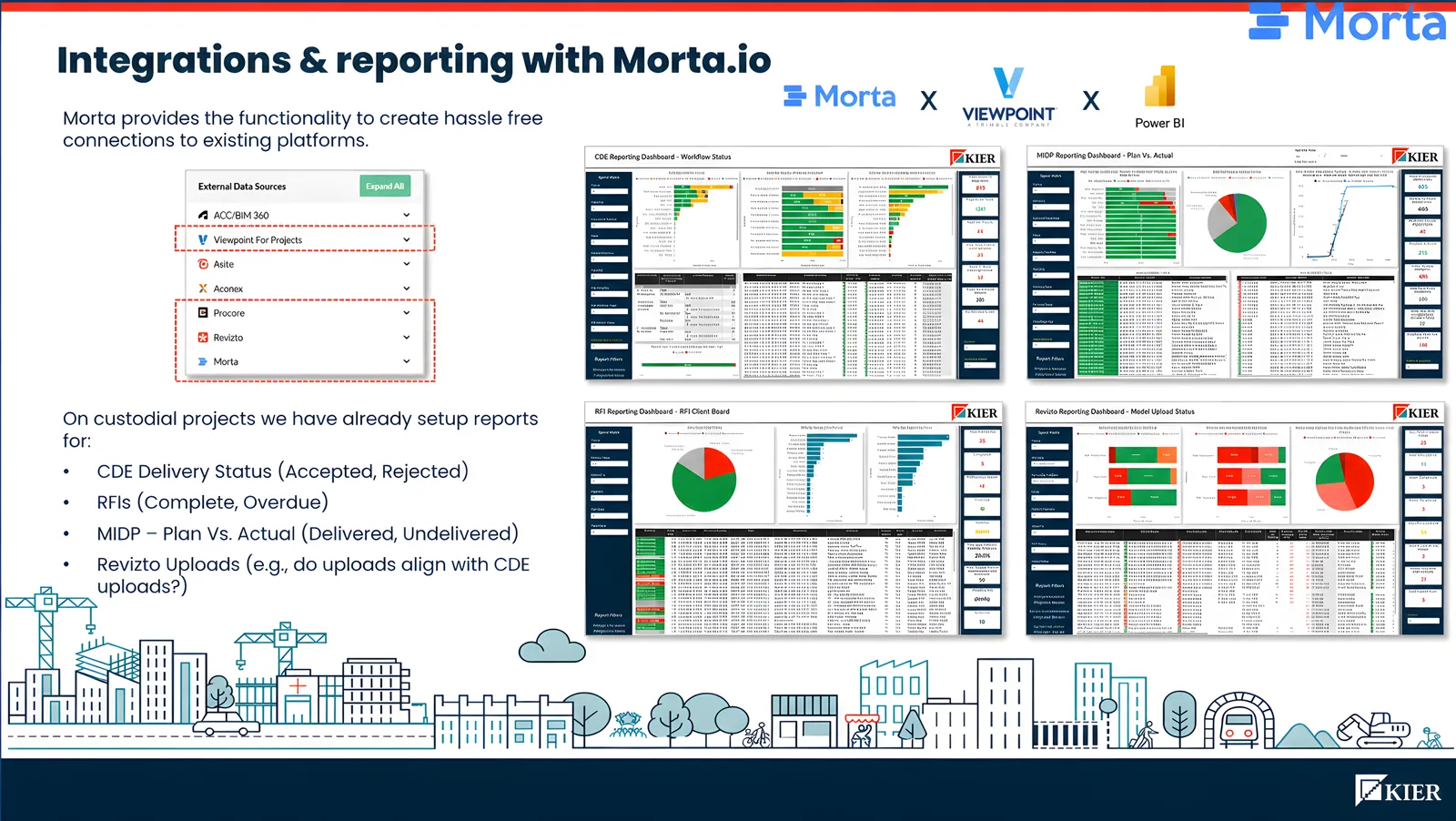
Project teams could inspect whether information was accepted or rejected, its workflow and its suitability code. Office-level views used the same connected data for comparison. Tom described two offices comparing how much information they had accepted. The reporting returned project detail and a wider view without requiring every user to read the same report.
Kier's custodial reports also covered completed or overdue requests for information, MIDP delivery against plan and whether Revizto uploads aligned with CDE uploads. These views let teams inspect different parts of information delivery using the relevant status and comparison.
Checking delivery and classification
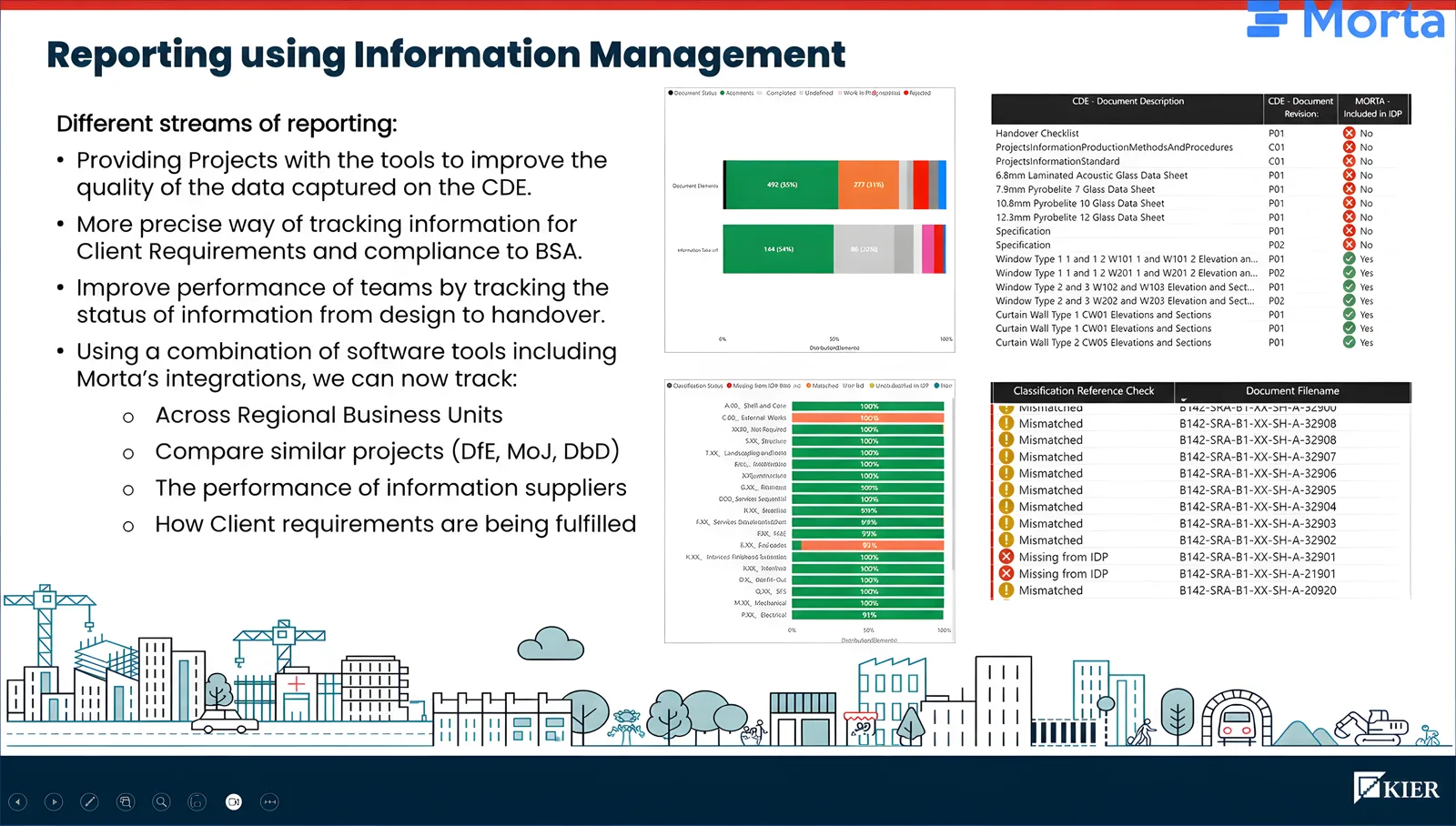
Kier checked whether information delivered into the CDE had been defined in the IDP. A flag showed whether it was included. It also checked Uniclass classifications against the values entered during planning, exposing mismatches between planned and delivered information. Project teams could see which items needed closer inspection.
That precision depended on people's understanding of the codes. Tom acknowledged that maintaining the detail could feel like micromanaging document information, particularly when contributors could not see why a role code or classification mattered beyond their project. Useful reporting returned a reason for that effort, while the checks made discrepancies visible.
Extending the use of the information
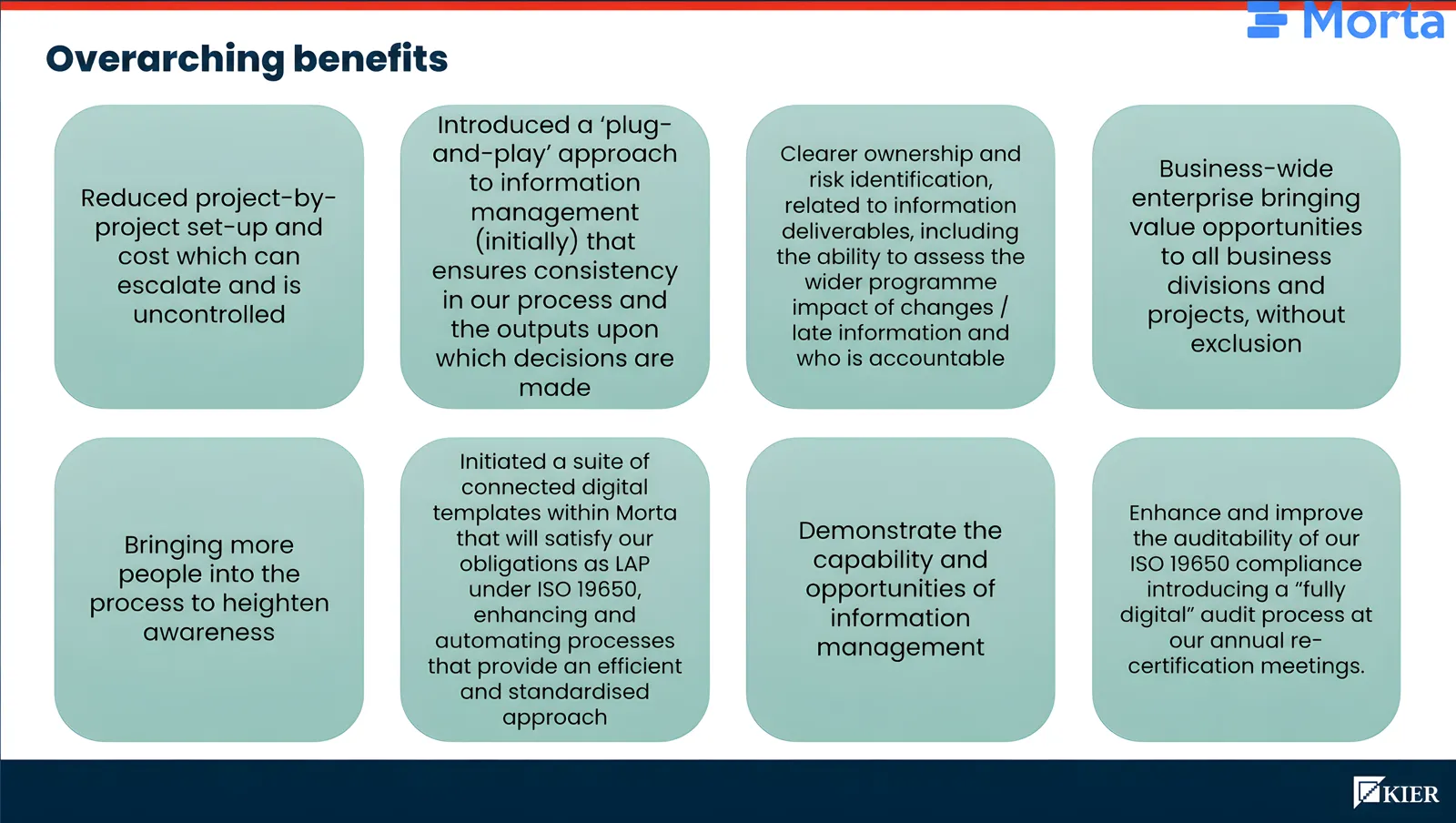
The early work brought template control, named responsibilities and delivery visibility together. Kier's benefits slide connected these to more controlled setup, clearer accountability for late information and wider awareness of information management. The team had also begun developing connected templates for its ISO 19650 obligations and wanted to make annual auditing more digital.
Colin placed business value first, followed by region and project, with supply-chain performance intended to inform future decisions. Dashboards were enablers because users could drill into information that meant something to their own work. Other platform integrations were already in testing, and the wider aim was to change how people understood and used connected project data.
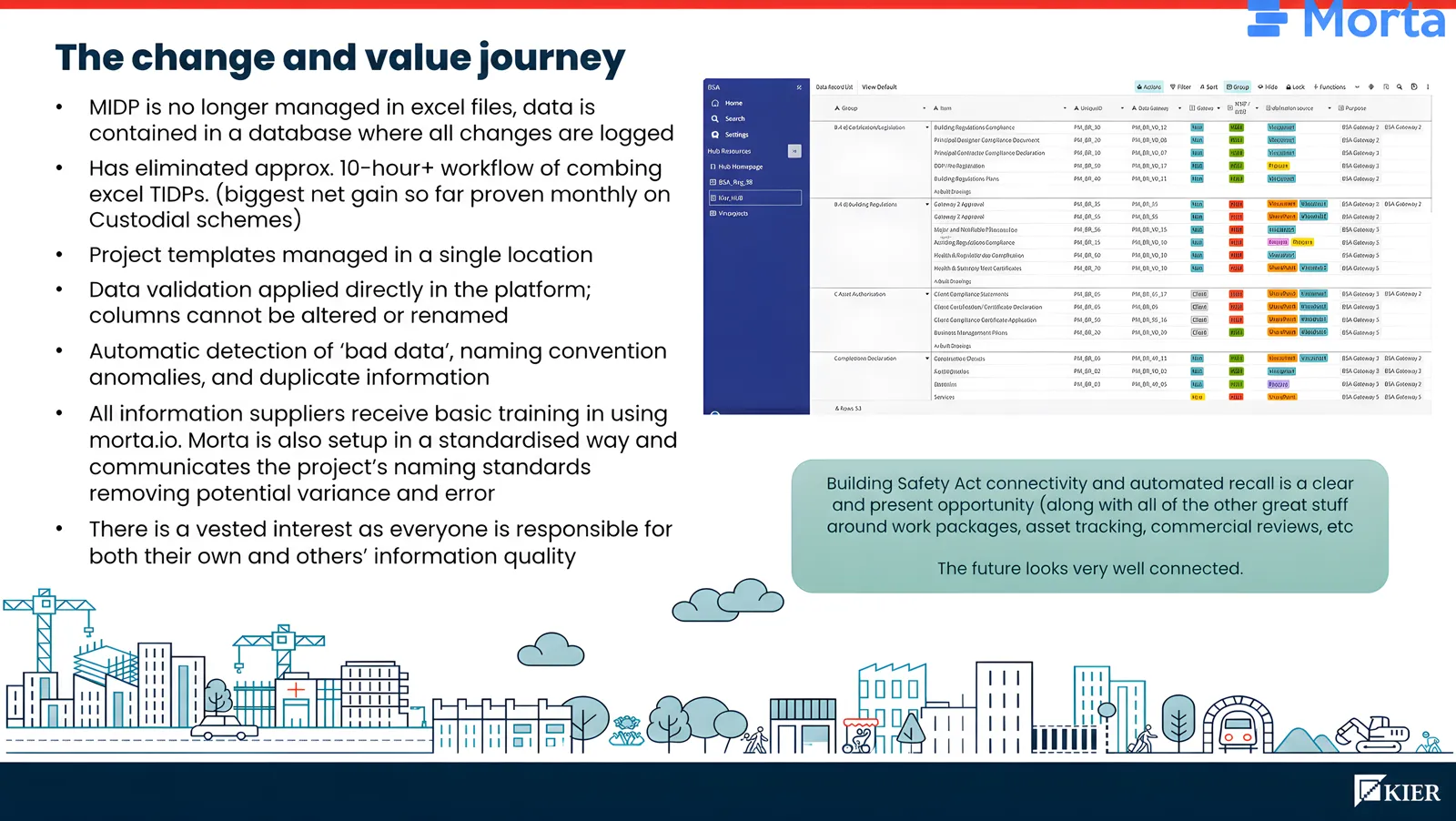
The closing slide brought together established controls, including logged changes, centrally managed templates, validation and supplier training. It also identified future opportunities to connect Building Safety Act information and automate its recall, alongside work packages, asset tracking and commercial reviews.
By August 2026, Kier was building on the IDP work with its supply chain. That later work carried forward the aim of using consistent performance information in decisions beyond the individual project.


